In recent years, industrial solid fires, forest blazes and lithium battery thermal runaway accidents have occurred frequently. Conventional water and foam fire extinguishing agents have obvious drawbacks: pure water evaporates rapidly, adheres poorly to surfaces and delivers unstained cooling effects; ordinary foam has weak thermal insulation and oxygen barrier performance, making it hard to prevent lithium battery fires from re-igniting. Water-based polymer fire extinguishing gels feature high water retention, strong surface adhesion, long-lasting flame retardancy and heat insulation, as well as eco-friendliness and non-corrosiveness. They have become an upgraded mainstream fire protection product widely used in industrial plants, energy storage power stations, outdoor storage tanks, forest fire prevention and other scenarios.
The core performance of fire extinguishing gels hinges on their thickening and gelling system. A single thickener cannot simultaneously satisfy three key indicators: surface adhesion, salt resistance and viscosity stability across high and low temperatures. For this reason, the mainstream technical route adopted by the industry is an interpenetrating network system formed by blending carbomer and xanthan gum (also known as Hansen gum). As a cross-linked polyacrylic resin, carbomer forms highly elastic gel after neutralization, featuring strong adhesion and outstanding high-temperature water retention, yet it suffers from poor ionic tolerance and severe viscosity loss under high-salt conditions. Xanthan gum, a microbial polysaccharide, boasts excellent resistance to salt, acid and alkali, stable suspension capacity and consistent viscosity at both high and low temperatures, which effectively offsets carbomer’s sensitivity to ions. When blended, the two substances form a dense interpenetrating network structure, enabling the gel to outperform single-component systems comprehensively in adhesion, wall-clinging water retention, combustion resistance, oxygen isolation and hard water tolerance. It can be applied to fire suppression for Class A solid combustibles, lithium batteries, timber, fabrics and other materials.
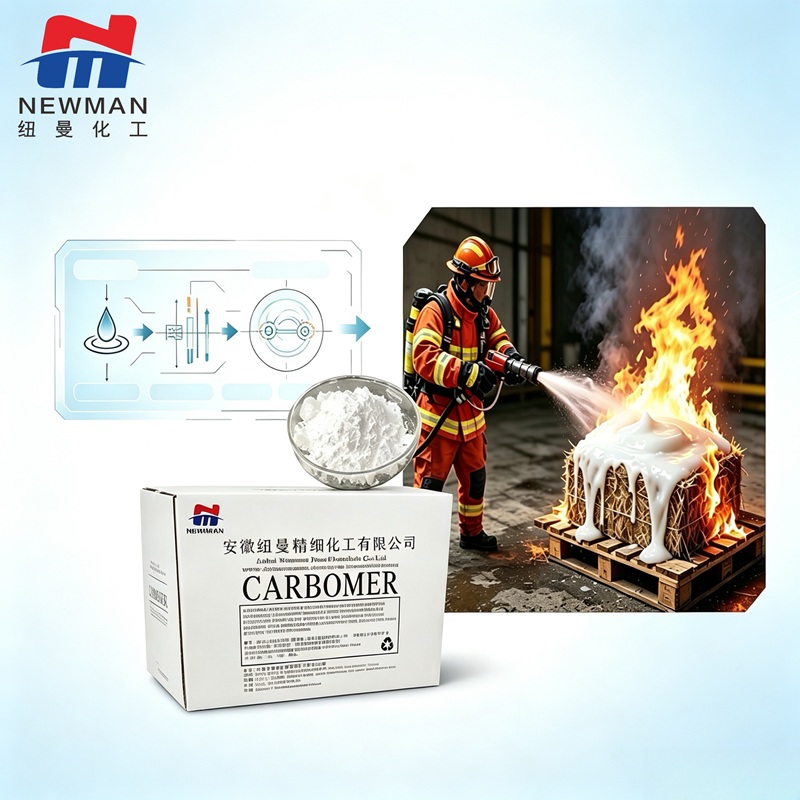
As a world-leading manufacturer of carbomer and acylates copolymers, Newman Chemical has developed different carbomers such as traditional carbomer 960, and 996, and electrolyte tolerance carbomer 2623 for fire extinguishing gels targeting three major fire protection scenarios—general civil use, low-temperature northern environments and lithium battery applications—based on the differentiated properties of its product line.
Formulation 1: General-Purpose Ambient-Temperature Fire Extinguishing Gel (Recommended for Civil & Factory Class A Fires)
|
Ingredients
|
Usage(wt.%)
|
Function
|
|
Deionized Water
|
95.20
|
solvents
|
|
NM-Carbomer 960, 996
|
0.30
|
Modifer theology
|
|
Xanthan Gum
|
0.15
|
Thickening and anti-hydrolysis
|
|
Glycerin (Glycerol)
|
2.00
|
Moisturizing & anti-freezing agent,
|
|
Triethanolamine (Neutralizer)
|
0.25
|
Neutralizer to pH 6.5–7.5 to form gel
|
|
Alkyl Polyglucoside APG0810
|
0.80
|
Penetrating & wetting agent
|
|
Sodium Benzoate
|
0.10
|
Preservative
|
|
Ammonium Dihydrogen Phosphate
|
1.20
|
Flame retardant & combustion inhibitor
|
Finished Product Viscosity: 12,000–18,000 mPa·s; long-lasting wall adhesion, no dripping upon spraying, freeze-resistant above -5℃ at ambient temperature.
Formulation 2: Low-Temperature Anti-Freezing Gel
|
Ingredients
|
Usage(wt.%)
|
Function
|
|
Deionized Water
|
91.75
|
solvents
|
|
NM-Carbomer 2623
|
0.35
|
Modifier rheology
|
|
Xanthan Gum
|
0.20
|
thickening
|
|
Ethylene Glycol
|
4.00
|
Anti-freezing performance down to -20℃
|
|
Glycerin
|
1.50
|
Anti-freezing performance
|
|
Triethanolamine
|
0.30
|
Neutralizer
|
|
Non-Ionic Surfactant APG
|
1.00
|
Penetrating & wetting agent, penetrates gaps of combustibles
|
|
Sodium Benzoate
|
0.10
|
Preservative
|
|
Ammonium Polyphosphate
|
0.80
|
Flame retardant & combustion inhibitor
|
Features: Carbomer 2623 enhances salt tolerance; ethylene glycol drastically reduces freezing point, ideal for outdoor storage tank fire fighting.
Formulation 3: High Thermal Insulation Gel Specialized for Lithium Batteries (Low Conductivity, Reignition Prevention)
|
ingredients
|
Usage(wt.%)
|
Function
|
|
Deionized Water
|
94.00
|
Solvent
|
|
NM-Carbomer 2623
|
0.40
|
Modifier rheology
|
|
Xanthan Gum
|
0.25
|
thickening
|
|
Propylene Glycol
|
2.20
|
Low electrical conductivity & anti-freezing
|
|
Triethanolamine
|
0.30
|
Neutralizer
|
|
Fluorocarbon/Hydrocarbon Composite Surfactant
|
0.75
|
Rapid spreading & film-forming capacity
|
|
Nano Aluminum Hydroxide
|
1.80
|
Heat absorption & thermal insulation, oxygen isolation
|
|
Phenoxyethanol
|
0.30
|
Antiseptic & bacteriostatic agent
|
Equipped with a full-spectrum carbomer product portfolio and years of in-depth research on blending technology, Newman Chemical develops customized raw material solutions tailored to different service environments and fire types. The carbomer-xanthan gum blend gel system meets the diversified current demands of fire protection. With excellent fire suppression performance, stable storage properties and eco-friendly features, it will remain the core choice for iterative upgrading of water-based fire extinguishing agents, helping comprehensively improve fire safety capacity in industrial sectors, energy storage facilities and forest fire prevention projects.
 en
en es
es